


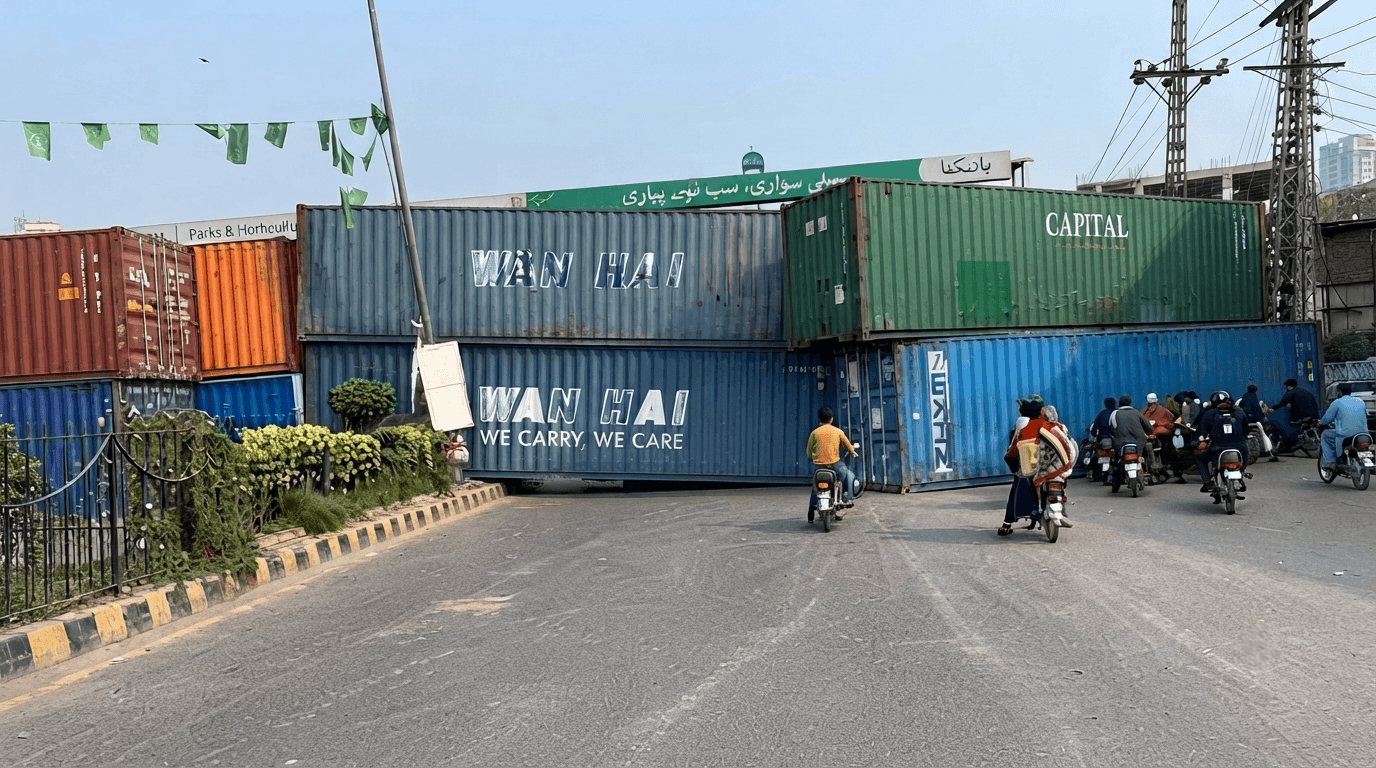
There is a striking number buried in Pakistan’s latest political confrontation: Rs46.5 million a day.
That is the reported daily rent for 1,550 containers arranged to block roads and restrict movement ahead of a Pakistan Tehreek-e-Insaf (PTI) protest in the capital, according to Dawn. If the containers remain in place for two weeks, their rental bill alone could reach Rs651 million. With police accommodation, food, transport and other security arrangements added, the total cost could exceed Rs1 billion.
The numbers raise a question that goes beyond the immediate political confrontation: what does it cost a state to stop a protest?
There is a legitimate public-interest argument for maintaining law and order during large demonstrations. Governments have a responsibility to protect citizens, public infrastructure and commercial activity. But when that responsibility turns into a large-scale mobilisation of police, vehicles, hotels and containers, the economic consequences become part of the political story.
In Islamabad, the bill is already accumulating.
According to Dawn, the capital police initially requested Rs820 million for security arrangements, including container rentals, accommodation and meals for police personnel arriving from Punjab and Sindh. Police had requested 16,000 personnel from Punjab and another 2,000 from Sindh.
The food bill alone illustrates how quickly the numbers grow. Three meals for the 2,000 Sindh police personnel were estimated at Rs1.2 million a day, while the estimated food bill for the requested 16,000-member Punjab contingent was Rs9.6 million a day. Hotel rooms and transport arrangements add further costs.
Then came the postponement.
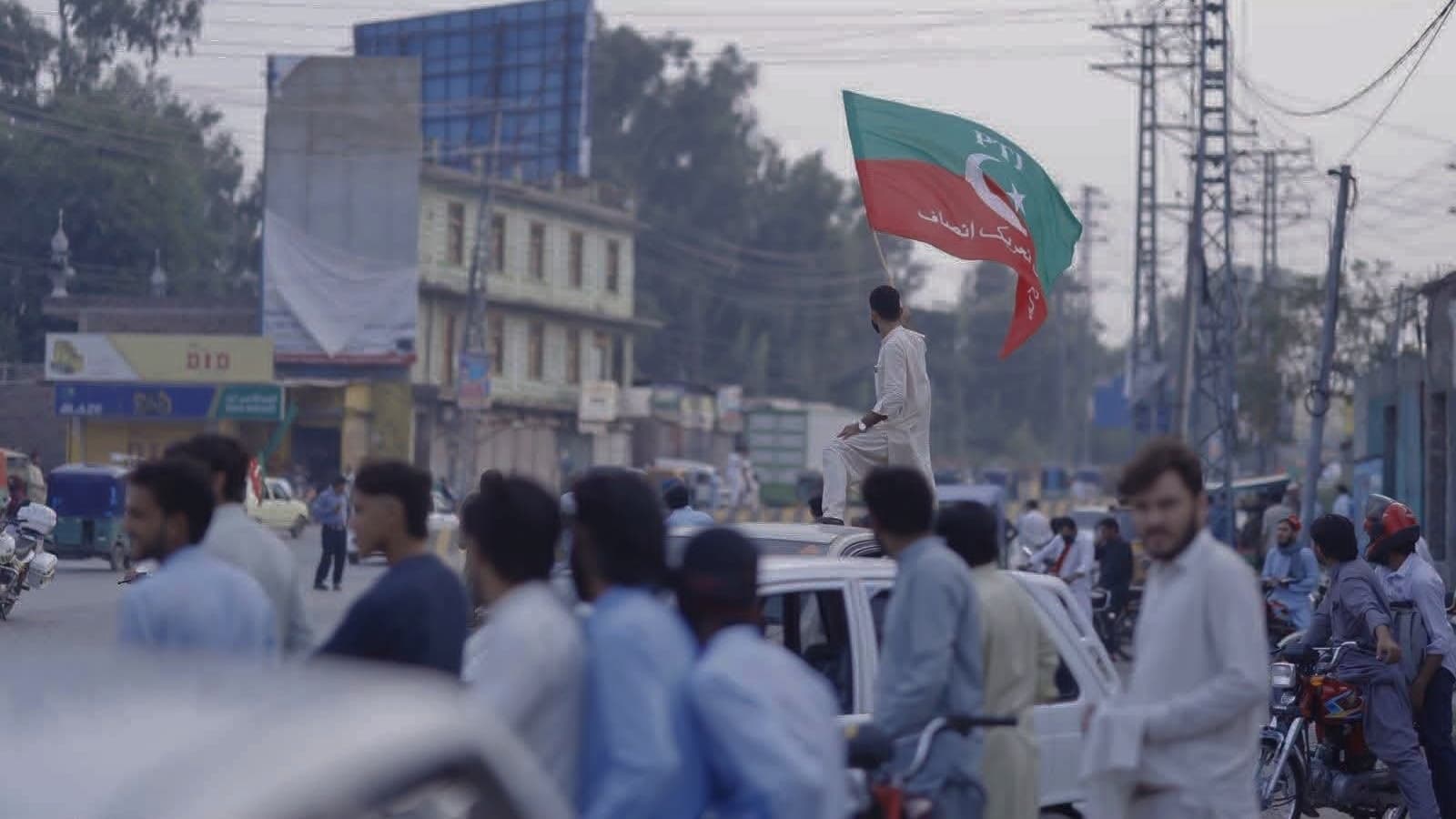
The PTI's long march towards Islamabad was originally scheduled for September 27. On September 25, Khyber Pakhtunkhwa Chief Minister Sohail Afridi announced that the party's political committee had agreed to postpone the march and that it would now commence from Peshawar on October 4.
That seven-day delay may sound like a political adjustment. Financially, however, it changes the equation.
The government had prepared for a confrontation expected to last roughly a week. The postponement means that containers, police deployments, accommodation, food and transport arrangements can remain in place for longer. Dawn reported that the security costs could effectively double and push the total expenditure beyond Rs1 billion.
This is where political time meets economic time.
A political party can move the date of a march from September 27 to October 4. But a container company's meter does not stop because the political calendar changes.
The containers continue to cost money.
The police still need food.
Vehicles still need to be hired.
Hotel rooms remain booked.
And the public treasury continues to carry the bill.
The government has, however, presented another side of the economic equation.
On September 20, Finance Minister Muhammad Aurangzeb warned in a recorded video message that protests and sit-ins could cause an estimated Rs120 billion in economic losses per day. His warning came ahead of planned PTI and Jamaat-e-Islami marches towards Islamabad. According to Dawn, the estimate was based on research findings.
The government said the estimate reflected the potential impact of disruption on different sectors of the economy. The services sector was estimated to account for around Rs86 billion of the daily loss, industry around Rs25 billion, and agriculture around Rs9 billion. An additional loss in tax revenue was also projected.
The figures should be understood for what they are: a government estimate of potential economic losses, not a confirmed daily loss already incurred.
But they demonstrate why the government regards the protest as an economic as well as a political issue.
The resulting calculation is uncomfortable.
On one side is the potential economic disruption caused by protests, road closures and interruptions to commercial activity.
On the other is the immediate and measurable cost of the extraordinary security operation designed to prevent that disruption.
These are not equivalent figures. One is a projected economic impact; the other is expenditure on security preparations. But together they reveal the scale of the economic stakes surrounding political confrontation.
There is also a less visible cost.
Dawn reported that police in Islamabad and Punjab had taken at least 2,700 vehicles and their crews into custody. Around 450 of those vehicles were reportedly carrying goods, including medicines, food and chemicals. The crews were being kept at police stations while authorities decided what to do with the vehicles and containers.
That turns a political security operation into a logistics problem.
A container is not simply a metal barrier placed across a road. It is part of a commercial chain. Behind it may be a driver waiting for payment, a transporter waiting for his vehicle, a manufacturer waiting for raw materials, a retailer waiting for stock or a customer waiting for a delivery.
When those vehicles stop moving, the economic consequences can travel far beyond Islamabad.
This is particularly significant in a country where the movement of goods connects farmers, factories, wholesalers, retailers and consumers across hundreds of kilometres.
The irony is difficult to miss.
The government says protests and road blockades can impose enormous economic costs. Yet the measures used to prevent the protest can themselves interfere with the movement of commercial vehicles and goods.
That does not make the security measures necessarily unjustified. It does, however, make their cost, duration and proportionality legitimate questions of public policy.
And the October 4 postponement brings those questions into sharper focus.
The march has not disappeared. It has moved.
The security bill, meanwhile, does not necessarily move with it.
If preparations remain in place until October 4, the state could spend considerably more before the protest even begins. If the march is then further delayed, the meter could continue running.
This is why the issue should not be reduced to whether the government has the right to maintain order or whether PTI has the right to protest.
The more useful question is how a state can manage political confrontation without turning every protest into a major economic operation.
A mature system of governance needs more than the ability to deploy containers. It needs mechanisms that allow political disputes to be managed without repeatedly converting public resources into emergency expenditure.
Dialogue is cheaper than prolonged mobilisation. Predictable rules are cheaper than emergency deployments. Keeping commercial vehicles moving is cheaper than disrupting supply chains. And a clear exit strategy is cheaper than allowing temporary security arrangements to become open-ended commitments.
Islamabad's containers have therefore become more than physical barriers.
They are a visible symbol of the financial machinery that accompanies political confrontation.
Rs46.5 million a day.
That is the reported price of the containers alone.
Add police food, accommodation, transport and other arrangements, and the bill moves towards — and potentially beyond — Rs1 billion.
The PTI's march was supposed to begin on September 27. It will now begin, according to the party's announcement, on October 4.
The political calendar has moved by seven days.
The financial meter, however, has not.
And that may be the most revealing cost of Pakistan's latest political standoff: the protest may be postponed, but the public expenditure required to prepare for it continues to accumulate.







回复 (0)