



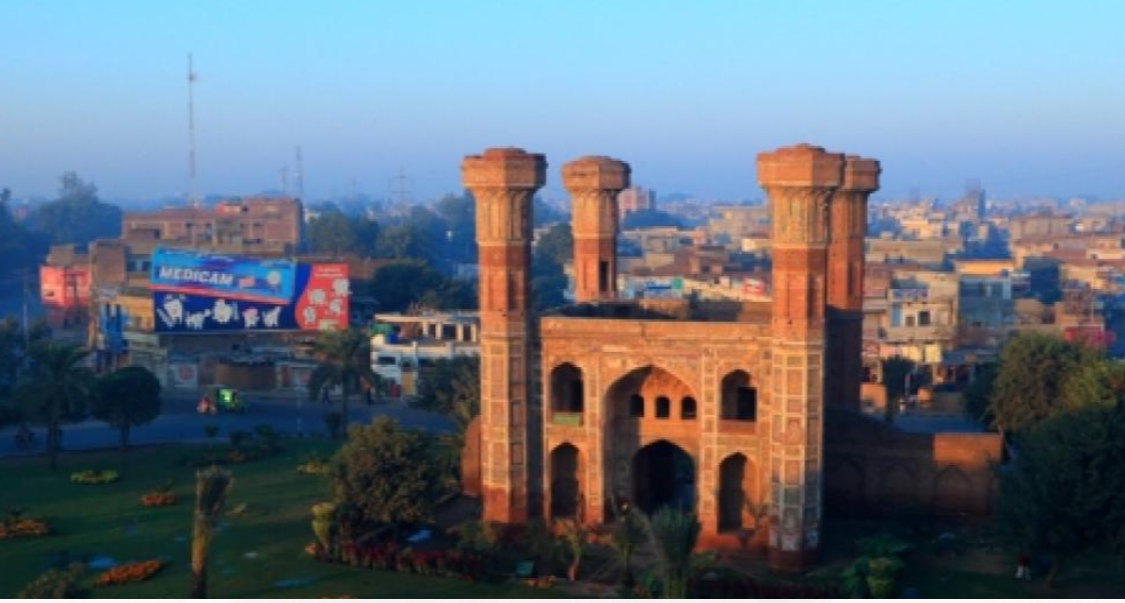
The historic Chauburji monument, located on Multan Road in Lahore, stands as a majestic 17th-century gateway to a grand Mughal garden that has long since vanished. Built in 1646 A.D., the structure earned its name—meaning "four minarets"—from its distinctive corner towers, though the northwest minaret was lost to time before modern restoration efforts.
The Mystery of Shahib-e-Zebinda
A fragmentary inscription on the eastern archway reveals that the garden was established by a noblewoman referred to as “Shahib-e-Zebinda, Begum-e-Dauran” (The Lady of the Age). History suggests this title likely refers to Jahan Ara Begum, the eldest daughter of Emperor Shah Jahan, who held the highest female rank in the empire following her mother's death in 1631.
While local folklore often attributes the site to Zeb-un-Nisa (the daughter of Aurangzeb), historians dismiss this theory. Born in 1639, Zeb-un-Nisa would have been only eight years old at the time of the garden's completion, making her an unlikely founder.
The Role of Mian Bai: Maid or Noblewoman?
The inscription further notes that the garden was bestowed upon a woman named Mian Bai. While some traditions label her a maid-servant, architectural evidence suggests a much higher social standing.
The southwest inscription refers to her as "Fakhr-un-Nisa" (The Pride of Women).
Her name is linked directly to the construction and management of the site.
The lavish scale of the gift implies she was a lady of significant status within the Mughal court.
Architectural Brilliance and Mosaic Art
The primary merit of Chauburji lies in its exquisite mosaic decoration. The entire façade, including the slender octagonal minarets, is brilliantly embellished with vibrant tile work that remains a hallmark of Mughal craftsmanship.
The main vault features a panel inscribed with the Ayat-al-Kursi (a verse from the Holy Quran) rendered in stunning blue enameled lettering. Beside this sacred text, the inscription marks the Islamic year A.H. 1056, confirming its completion nearly four centuries ago.
Who built Chauburji in Lahore?
Chauburji was commissioned in 1646 A.D. by a royal lady known as "Shahib-e-Zebinda," likely Jahan Ara Begum, the daughter of Emperor Shah Jahan, and bestowed upon a noblewoman named Mian Bai.
What does the word 'Chauburji' mean?
The name "Chauburji" translates to "four minarets" in Urdu/Persian, referring to the four octagonal towers located at each corner of the monument.
Where is Chauburji located?
Chauburji is situated on Multan Road in Lahore, Pakistan. It originally served as the monumental gateway to a vast Mughal garden that no longer exists.













Responses (0)