

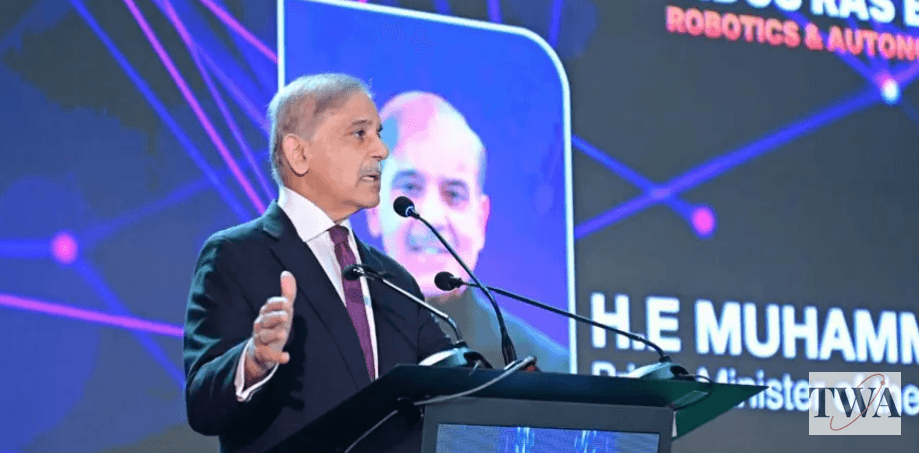
Prime Minister Muhammad Shehbaz Sharif on Thursday urged academia, research institutions, startups, industries and the farming community to work together in building a strong national innovation ecosystem, stressing that Pakistan must develop, own and continuously advance the knowledge underpinning emerging technologies.
Speaking at the opening ceremony of the Indus RAS – Robotics and Autonomous Systems Expo 2026, the prime minister said the rise of robotics and autonomous systems should not be limited to developed nations, large corporations or metropolitan centres. Instead, he said, these technologies should be harnessed to promote inclusive development by empowering farmers, small and medium-sized businesses, women entrepreneurs, young innovators and underserved communities across Pakistan and the wider Global South.
The event was attended by Chief of Defence Staff and Chief of Army Staff Field Marshal Syed Asim Munir, federal ministers, technology experts, industrialists, entrepreneurs, international delegates, company representatives and students, APP reported.
The prime minister also underscored the importance of responsible innovation, saying the rapid evolution of emerging technologies requires effective regulatory and ethical frameworks to ensure autonomous systems remain safe, secure, transparent and serve the broader interests of humanity.
He reaffirmed the government's commitment to promoting innovation while ensuring these technologies are deployed responsibly and inclusively for sustainable national progress.
The prime minister unveiled two landmark initiatives set to shape the country's robotics and autonomous systems landscape: the Spark and Elevate programme, aimed at converting Pakistan's research output into world-class technologies, globally competitive enterprises and high-productivity jobs; and the Pakistan Venture Fund, launched with an initial commitment of $20m to catalyze investment in the country's technology ecosystem.
Describing the future Pakistan envisions in robotics and autonomous machines, the prime minister said it represents the story of a nation of roughly 250m resilient people determined to re-imagine, compete and build a better future for coming generations driven by the curiosity and ingenuity of the country's young talent.
He said Pakistan stands at the cusp of a historic opportunity that must not be missed, adding that the country will shape its own destiny through innovation, enterprise and self-reliance rather than inheriting choices made by others.
Calling the Indus RAS Expo a landmark initiative reflecting Pakistan's ambition to lead in technologies that will define the 21st century, the prime minister recalled that the country earlier this year hosted the Indus AI Summit, bringing together governments, technology leaders, researchers and entrepreneurs to chart Pakistan's course in the age of artificial intelligence.
He said the RAS Expo gave that vision tangible form by demonstrating how innovation can be translated into solutions that strengthen the economy, enhance security and improve people's lives.
Reflecting on the pace of technological change, Shehbaz Sharif observed that machines today no longer merely calculate but can perceive, decide and act swiftly, noting that emerging technologies have brought a revolution to the agriculture sector long at the mercy of water scarcity, rising input costs, fragmented land holdings and unpredictable climate and have also helped save lives during crises when roads and bridges were washed away.
On defence, the prime minister said Pakistan has made remarkable progress in developing indigenous autonomous capabilities, crediting the armed forces under Field Marshal Syed Asim Munir for adopting cutting-edge technologies, including simulators fully manufactured and assembled locally and drones that have achieved more than 60% indigenization.
He also commended the IT ministry, experts, professionals and technocrats for their contribution to these achievements.
Recalling last year's Marqa-e-Haq, the prime minister said the armed forces demonstrated their ability to guard Pakistan's physical and cyber frontiers through the effective use of advanced autonomous systems, under the leadership of Field Marshal Syed Asim Munir and supported by Air Chief Marshal Zaheer Ahmed Babar Sidhu and Naval Chief Admiral Naveed Ashraf.
He said this proved Pakistan possesses not only the resolve to safeguard its sovereignty but also the indigenous capability and technological prowess to deploy advanced autonomous systems in its defence, adding that these advancements would further strengthen the country's security architecture and resilience against emerging threats.
Earlier at the ceremony, Minister for IT Shaza Fatima Khawaja said countries leading in new technologies will define the future global economy, adding that Pakistan intends to own full value chains of robotics and artificial intelligence as a matter of national policy.
She said the government, under the prime minister's leadership, has embraced the vision of a Digital Nation Pakistan, treating technology not as a mere economic lever but as an engine of productivity, employment and national competitiveness.
The minister said the government is creating an enabling environment for startups, investors and young people to compete globally, pointing to the country's ICT exports growing by nearly 21% this year, along with a 14-rank improvement in the E-Governance Development Index and a 27-rank rise in the ITU's ICT Development Index.














回复 (0)