


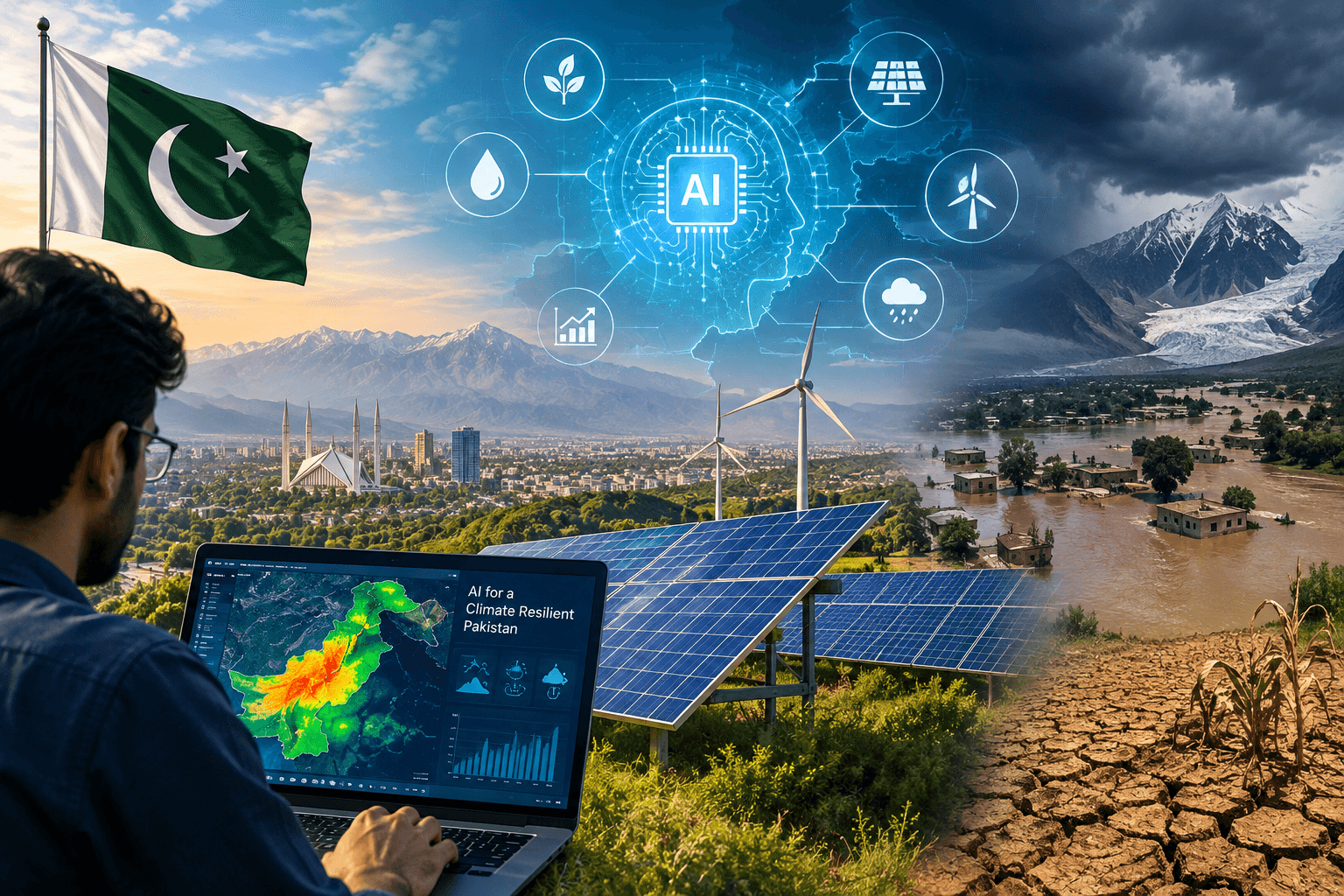
Climate change is no longer a distant environmental challenge. It is increasingly a technology challenge: how quickly societies can predict extreme weather, manage energy, protect food systems and infrastructure, and deploy cleaner technologies at scale.
For countries such as Pakistan, the stakes are particularly high. Pakistan contributes less than 1 percent of global greenhouse-gas emissions but remains among the countries most vulnerable to climate impacts. The country’s recent experience with floods, extreme heat, water stress and air pollution demonstrates why climate action cannot rely on policy alone. It increasingly requires better data, artificial intelligence, renewable energy and digital infrastructure.
Artificial intelligence could become one of Pakistan’s most important tools for climate adaptation. AI models can analyse rainfall, river levels, satellite imagery and temperature data to identify emerging risks and improve early-warning systems. Pakistan’s Ministry of Climate Change has already highlighted AI’s potential for disaster preparedness and climate governance, particularly because fragmented data remains a major obstacle to effective policymaking.
The country’s technology community is also beginning to explore practical applications. Pakistan’s URAAN AI Techathon, for example, has identified energy and climate resilience as areas where AI solutions could address real national problems, including electricity-demand forecasting, flood and heatwave alerts, and climate-risk modelling using satellite and environmental data.
Energy is another major part of the equation. Pakistan has significant potential for solar, wind and hydropower, and its latest climate commitments place greater emphasis on renewable and clean-energy capacity. Under Pakistan’s NDC 3.0, renewable energy, including hydropower, is projected to become a dominant part of planned electricity capacity by 2035.
Technology can also create an industrial opportunity. In Sindh, a new Special Technology Zone is being developed around renewable-energy manufacturing and emerging technologies, with plans involving solar panels, batteries, wind systems, electric-vehicle charging equipment, inverters and AI-related infrastructure. If successfully implemented, such projects could move Pakistan beyond simply importing climate technologies toward developing parts of the technology ecosystem domestically.
But technology is not a silver bullet. AI itself requires electricity, data centres consume resources, and digital infrastructure can be vulnerable to floods, heat and other climate shocks. The World Bank has therefore stressed the importance of combining digital expansion with energy efficiency, renewable power and climate-resilient infrastructure.
Pakistan’s challenge is ultimately one of execution. The country needs reliable climate data, stronger research institutions, investment in clean technologies, skilled engineers and entrepreneurs, and mechanisms that turn promising pilot projects into systems used by governments and communities.
For Pakistan, climate technology should not be viewed simply as a tool for reducing emissions. It can also become a tool for protecting lives, strengthening energy security, modernising agriculture, creating technology jobs and building resilience.
The question is no longer whether technology can help Pakistan respond to climate change. The more important question is whether Pakistan can scale the technologies it already has—and develop the next generation fast enough.















回复 (0)