


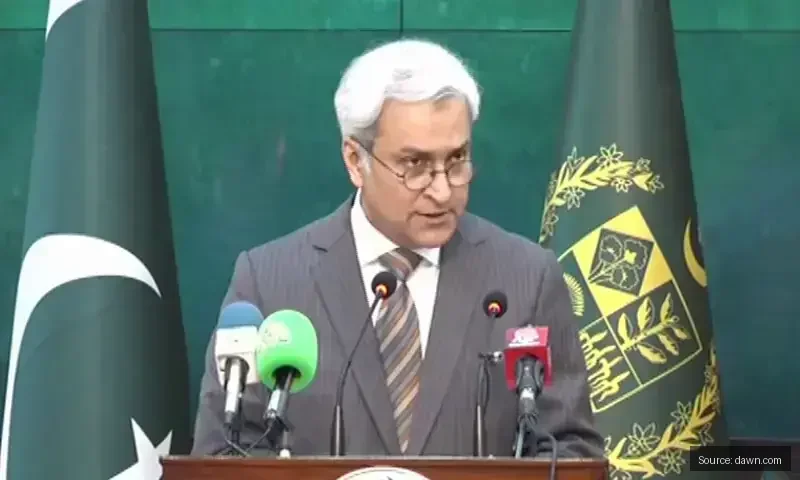
Pakistan’s Foreign Office unequivocally dismisses recent criticism from India regarding its ongoing cross-border actions in Afghanistan. Islamabad labels the Indian Ministry of External Affairs’ statement as "absurd, unwarranted, and shamefully hypocritical," intensifying the diplomatic standoff between the two nuclear-armed neighbours.
This strong rebuttal follows India's condemnation of Pakistan’s military operations, specifically "Operation Ghazab lil-Haq." Launched in late February, this operation targets militant hideouts after a series of unprovoked cross-border attacks by the Afghan Taliban.
Pakistan Defends Its Cross-Border Actions Against Terror
A spokesperson for the Indian MEA, Shri Randhir Jaisal, had previously asserted that Pakistan's strikes in Afghanistan resulted in civilian casualties, characterizing them as an "act of aggression." However, Foreign Office spokesperson Tahir Andrabi firmly refutes these allegations.
Andrabi states that Pakistan’s measures constitute "legitimate, targeted, and precise actions against terrorist hideouts and support bases inside Afghanistan." He emphasizes that India’s remarks are not only baseless but also reveal a deep hypocrisy.
Islamabad further alleges India's "active support and sponsorship" of various terrorist factions operating from Afghan territory. These groups include Fitna-al-Khawarij, a term used for the banned Tehreek-i-Taliban Pakistan, and Fitna-al-Hindustan, referring to terrorist organizations in Balochistan.
The Foreign Office suggests that India's "frustration" stems from the disruption of its perceived "terrorist franchise" within Afghanistan. This sentiment, they argue, explains the nature of such accusatory statements.
India's 'Hypocritical' Stance and Regional Meddling
Pakistan's statement also highlights India's own human rights record and its historical actions. It references India's "illegal occupation" of Indian Illegally Occupied Jammu and Kashmir, asserting violations of the United Nations Charter and relevant UN Security Council resolutions.
Furthermore, Pakistan accuses India of perpetrating state terrorism in the occupied territories. It points to India's "Hindutva extremist ideology" as a driver for the systematic marginalization of minorities, the spread of Islamophobia, and even the weaponization of water resources in breach of treaty obligations.
The Foreign Office concludes that India has consistently acted as a "spoiler" not only in Afghanistan but across the entire region. Given its "shameful credentials," India is deemed to be in "no position" to issue such critical statements.
Islamabad urges New Delhi to instead focus on preventing the "stoking of terrorism inside Pakistan from Afghan soil." Pakistan reiterates its commitment to take all necessary and appropriate actions for self-defence and to safeguard its citizens, fully adhering to international law and the UN Charter.
This latest exchange echoes a heated debate at the UN Security Council on March 10, where Pakistan's Permanent Representative, Ambassador Asim Iftikhar Ahmad, strongly challenged India's criticism of its cross-border operations. He then accused Delhi of animosity towards Pakistan and of pursuing an Afghan policy solely aimed at destabilizing Pakistan by supporting groups like the Tehreek-i-Taliban Pakistan and Baloch Liberation Army.
This long-standing tension was also underscored in October last year when Defence Minister Khawaja Asif stated that India was engaged in a "low-intensity" war against Pakistan from Afghanistan, seeking to "settle the score" after past conflicts.
Source: dawn.com








Responses (0)