


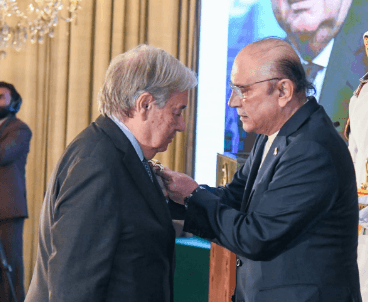
Islamabad, Pakistan: President Asif Ali Zardari has conferred Pakistan’s Nishan-e-Imtiaz, one of the country’s highest civilian awards, on United Nations Secretary-General António Guterres in recognition of his international service, leadership of the world body and contribution to global peace and development.
The award was presented during a special investiture ceremony at Aiwan-e-Sadr in Islamabad on Tuesday. It is the first time Pakistan has conferred the Nishan-e-Imtiaz on a serving or former UN secretary-general.
Prime Minister Muhammad Shehbaz Sharif, Speaker of the National Assembly Sardar Ayaz Sadiq, Deputy Prime Minister and Foreign Minister Mohammad Ishaq Dar, members of the federal cabinet, parliamentarians and members of the diplomatic corps attended the ceremony.
During a meeting earlier in the day, President Zardari praised Guterres’s leadership at the United Nations and his efforts to promote international peace, dialogue, diplomacy and the peaceful resolution of disputes. He also acknowledged the UN chief’s engagement with Pakistan and his attention to the concerns of developing countries.
Zardari reiterated Pakistan’s support for the Palestinian people and their right to self-determination. He welcomed Guterres’s continued advocacy for Palestinian statehood and a two-state solution, while reaffirming Islamabad’s support for efforts to implement relevant UN Security Council
resolutions.
The Pakistani president also outlined Islamabad’s position on peace and stability in South Asia, saying lasting peace required sustained dialogue between Pakistan and India and the resolution of outstanding disputes, particularly Jammu and Kashmir, in accordance with relevant UN resolutions and the aspirations of the Kashmiri people.
He further said the Indus Waters Treaty remained a binding international agreement and could not be unilaterally suspended or placed in abeyance. Pakistan, he added, opposed the use of water as a tool of political pressure and maintained that its rights under the treaty should be respected.
On regional diplomacy, Zardari said Pakistan’s diplomatic initiatives, including the Islamabad Talks, had focused on de-escalation, dialogue and the protection of human life. He reiterated Islamabad’s willingness to facilitate diplomatic efforts where it could contribute to reducing tensions, stressing that dialogue remained essential for resolving regional disputes.
The president also discussed counterterrorism and Afghanistan, reaffirming Pakistan’s role as a partner in international efforts against terrorism. He said the country had made significant sacrifices in the fight against terrorism and continued to face security threats from groups operating from Afghan territory.
Zardari maintained that Afghan territory should not be used against Pakistan or any other country, while reiterating Islamabad’s commitment to dialogue and regional cooperation alongside measures to protect its people and territory in accordance with international law.
Pakistan’s contribution to UN peacekeeping was also highlighted during the meeting. Zardari noted that more than 270,000 Pakistani peacekeepers had served in 48 UN missions around the world, reaffirming the country’s commitment to peacekeeping as an important instrument for maintaining international peace and security.
The president also welcomed Guterres’s leadership of the UN80 Initiative, which seeks to improve the efficiency and effectiveness of the United Nations. He said any reform process should protect the interests of developing countries while strengthening sustainable development, conflict prevention, peacekeeping and peacebuilding.
Zardari expressed hope that the next UN secretary-general would continue the reform process while maintaining the United Nations’ central role in promoting peace, development and international cooperation.
Climate change was another major issue discussed during the meeting. Zardari described climate change as an existential challenge for highly vulnerable developing countries such as Pakistan and called for stronger international action on mitigation, adaptation and climate finance.
He also reiterated Pakistan’s support for reforming the UN Security Council and increasing representation through elected, non-permanent members based on equitable geographical representation.
Guterres was accompanied by UN Under-Secretary-General Rosemary DiCarlo and UN Resident Coordinator a.i. Pernille Ironside. Deputy Prime Minister and Foreign Minister Mohammad Ishaq Dar, Senator Sherry Rehman, Senator Saleem Mandviwalla and former federal minister Naveed Qamar were also present.
Zardari praised Guterres for his personal solidarity with Pakistan following the devastating floods of 2022. He recalled the UN chief’s visit to flood-affected areas and his efforts to mobilise international assistance and support the Geneva pledging process.
The president also highlighted Pakistan’s post-flood reconstruction programme, which included the construction of about 2.1 million climate-resilient homes, with ownership assigned to women members of beneficiary households. He described the initiative as an example of linking climate resilience, reconstruction and women’s economic empowerment.
In his remarks, Guterres reflected on his experiences in Pakistan, including the country’s hospitality towards millions of refugees, its resilience in confronting terrorism and the solidarity shown by its people in times of crisis. He said his understanding of Pakistan was shaped by seeing these realities firsthand and expressed gratitude for the honour, while also acknowledging Pakistan’s contributions to the wider international community.





Responses (0)