
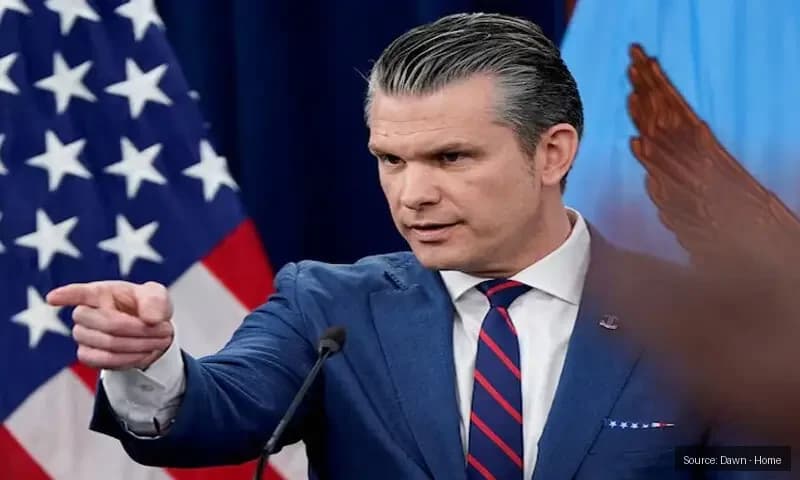
US Defense Secretary Pete Hegseth's recent pronouncements concerning joint US-Israeli combat operations in Iran signal a dramatic shift in official communication regarding military action. His remarks, made on March 2, 2026, stand in sharp contrast to the measured language previously employed by officials like former US Secretary of Defense James Mattis, who emphasized strategy and protecting innocents.
Hegseth boldly asserted a focus on decisive victory, stating, "We fight to win." He dismissed traditional concerns about "stupid rules of engagement," a "nation-building quagmire," or "politically correct wars," following boasts about the formidable power of American military assets, including B-2s, fighter jets, drones, and missiles. He also admonished media outlets and the political left, demanding they "Stop" their "endless wars" narrative, asserting, "This is not Iraq."
Two days later, Hegseth continued to celebrate "dominance" and "control." He attributed media preoccupation with casualties to liberal bias and animosity towards President Trump, claiming, "Tragic things happen — the press only wants to make the president look bad." He dismissed rules of engagement, declaring the conflict "was never meant to be a fair fight" and that "We are punching them while they are down, as it should be."
A Stark Shift in Official US War Rhetoric
A communications scholar, who has extensively studied far-right rhetoric for a decade, observes that Hegseth and other officials in the second Trump administration appear to reject the conventional demands placed on public figures during urgent national matters. This administration's ethos suggests a refusal to be constrained by norms or the exigencies typically compelling speech in a democratic society.
During wartime, the public expects leaders, including the President and Defense Secretary, to justify military actions and address the nation with seriousness and competence. However, Hegseth's initial press briefings on the Iran conflict deviated significantly from this expected measured tone.
Hegseth employed villainous colloquialisms such as "they are toast and they know it," "we play for keeps," and "President Trump got the last laugh." These were delivered with a combative tone, conveying an overtly masculine self-assurance. Many observers expressed surprise at his haughty demeanor, a hypermasculine preoccupation with domination, and a seemingly casual attitude toward violence and death.
The Far-Right Influence on Military Discourse
While rule-breaking behavior was largely confined to President Trump during his first term, his second administration prioritizes loyalty. It has appointed numerous right and far-right media personalities, including Hegseth, Kash Patel, Sean Duffy, and Mehmet Oz. This anti-institutional ethos, prevalent in far-right media, explains why these officials eschew "elite" expectations, opting instead for bombastic, outrageous, and provocative language.
Within this environment, there is minimal reverence for traditional rules of politeness, which may be perceived as emasculating. In a media landscape where "owning," "dominating," and "triggering" opponents are prized, far-right media figures excel at commanding attention through showmanship and swagger. This dynamic suggests Trump likely selected Hegseth precisely for his ability to embody this "big man" persona.
Gamifying Conflict: The Language of 'Kill Talk'
Hegseth's choice of language and petulant tone do not indicate ignorance of rhetorical norms but rather a deliberate refusal to conform. During statements about the war's first week, he grinned while delivering action-movie-style one-liners, such as, "turns out the regime who chanted 'Death to America' and 'Death to Israel' was gifted death from America and death from Israel."
Hegseth engaged in what is known as "kill talk," a verbal strategy often directed at new military recruits that dehumanizes the enemy and obscures the horrific costs of violence. His repeated use of words like "death," "killing," "destruction," "control," "warriors," and "dominance" framed violence in heroic terms, detached from the grim realities of war.
The scholar suggests Hegseth addressed the public as a squad leader might address military recruits, appearing to revel in dispensing death and glorifying conflict, with little mention of long-term strategy beyond "winning." In the 'Maga' media sphere, winning is paramount. This singular focus implies war is akin to a game, a test of masculine fortitude.
This perspective was further underscored by a White House video that interspersed actual airstrike footage from Iran with "killstreak animation" from the popular video game Call of Duty: Modern Warfare. Such messaging gamifies violence and further obscures the destructive toll of armed conflict. Ultimately, this behavior, informed by the contemptuous hypermasculinity of far-right media culture, conveys a fundamental message: when the public most needs explanation and justification for government actions, the powerful owe them neither explanation nor comfort.
Source: Dawn - Home








Responses (0)