


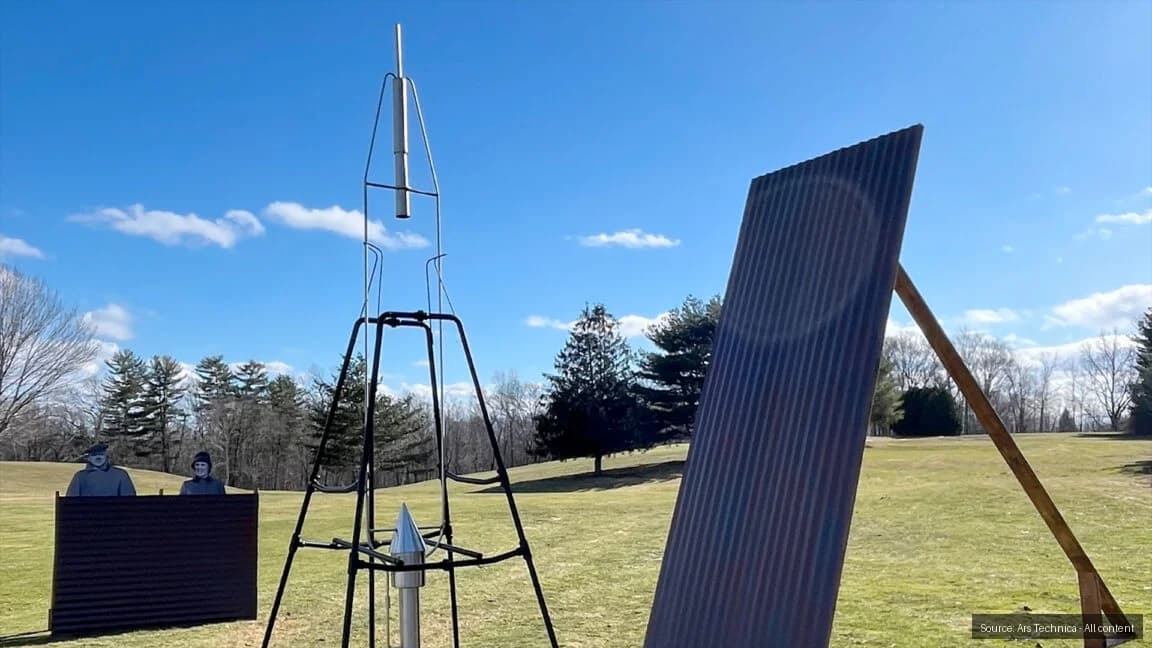
One hundred years ago, on March 16, 1926, Robert Goddard launched a device that would forever change humanity's reach: the world's first liquid-fueled rocket. This monumental achievement, taking place in a snow-covered field in Auburn, Massachusetts, marked the dawn of practical rocketry. Yet, a century later, the physical remnants of Goddard's first rocket are nowhere to be found, leaving historians and enthusiasts to ponder its fate.
The Historic Launch and Its Elusive Remnants
The pioneering flight lasted a mere 2.5 seconds, reaching an altitude of 41 feet and traveling 184 feet across the field. Despite its modest scale, this event proved the viability of liquid propulsion, a concept many of Goddard's contemporaries dismissed as impractical. His innovation laid the groundwork for all future space exploration.
Unlike many artifacts of such historical significance, Goddard's first rocket was not preserved as a sacred object. Dr. Goddard was a relentless experimenter, constantly iterating and improving his designs. His focus remained firmly on the next breakthrough, not on archiving past prototypes.
It is understood that the rocket, likely damaged from its landing, was simply part of the ongoing research process. Components may have been salvaged for future experiments, or the entire assembly could have been discarded. The meticulous preservation efforts we associate with historical objects today were not a priority for Goddard or his small team.
Goddard's Vision and Lasting Legacy
Robert Goddard’s work was characterized by an unwavering dedication to scientific advancement. He conducted hundreds of tests, meticulously documenting his findings in journals and patents, but often neglecting the physical preservation of his early machines. This approach highlights his role as a pure scientist and inventor, driven by discovery rather than historical curation.
His contributions are foundational to modern rocketry, influencing figures from Wernher von Braun to the engineers of NASA. Though Goddard's first rocket itself is lost to time, its impact resonates powerfully. It stands as a testament to the power of a single idea, meticulously pursued, even when the physical manifestation of that idea fades.
Today, museums display replicas and detailed schematics, ensuring his legacy endures. The mystery of the original rocket’s disappearance only adds to the intrigue surrounding one of history's most significant technological leaps.
Reference: Ars Technica - All content












Responses (0)