
FIFA has abandoned its plan to sell a minority stake in the commercial rights of the FIFA World Cup and other tournaments after fierce global criticism.
The decision follows boycott threats, internal resignations and growing pressure on FIFA President Gianni Infantino.
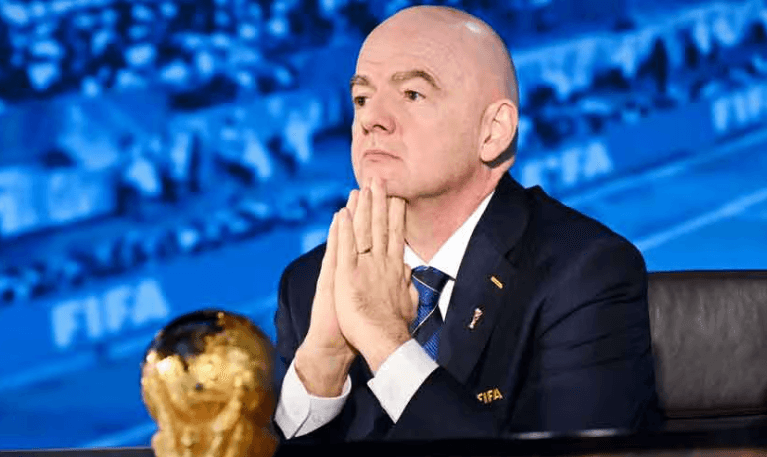
FIFA President Gianni Infantino announced on Friday that world football's governing body will no longer proceed with its proposal to sell a stake in the FIFA World Cup and other commercial assets to private investors.
In a statement, Infantino said the governing body had reconsidered the proposal after listening to the concerns raised by stakeholders across global football.
"Having listened carefully to all the views, it has become clear that the project has created divisions of a nature that, regardless of the level of support, are no longer in the interest of the objective set out in the first place," he said.
He added that FIFA's purpose has always been "to unite and improve" the game and confirmed that the proposal would not move forward.
Proposal aimed to raise $4.2 billion
The proposal, unveiled earlier this week, sought to raise up to $4.2 billion by selling approximately a 20 percent stake in a newly created commercial subsidiary known as FIFA Forward Enterprise (FFE).
The new entity would have managed FIFA's revenue-generating operations, including the men's and women's FIFA World Cups, the Club World Cup, broadcasting rights, sponsorship agreements, ticket sales and hospitality.
The proposal valued the new business at around $20 billion.
The lead investor was expected to be Thrive Eternal, launched by Joshua Kushner, whose brother Jared Kushner is the son-in-law of US President Donald Trump.
FIFA promised higher payments to member associations
FIFA argued that bringing in outside investment would generate billions of dollars to support football development around the world.
Infantino wrote to FIFA's 211 member associations, offering an optional $20 million payment if they agreed to the proposal before the September 19 deadline.
Under the proposed structure, member associations would have received $20 million each over the next funding cycle instead of the previously planned $10 million.
FIFA also projected that distributions would increase further to $22 million through 2034 and $24 million through 2038.
Many smaller football associations, including those in countries such as Andorra, Montserrat and Papua New Guinea, stood to benefit significantly from the additional funding, while larger football nations such as England, Spain and France expressed different priorities.
Fierce opposition emerges across world football
Despite FIFA's financial arguments, the proposal immediately sparked widespread resistance.
Critics argued that the FIFA World Cup should remain a sporting competition rather than become an investment product controlled by private equity interests.
Many observers also expressed concern that private investors would seek greater financial returns by expanding tournaments and increasing the number of matches, placing further pressure on an already congested international football calendar.
UEFA leads boycott threat
The strongest opposition came from UEFA, whose 55 member associations unanimously agreed on Thursday to boycott FIFA competitions unless the proposal was withdrawn.
UEFA accused FIFA of putting the "soul" of football up for sale and insisted that the World Cup could not be treated as an investment product.
The concern was particularly significant because European nations consistently dominate FIFA's biggest tournaments, including the men's FIFA World Cup and Club World Cup, which generate much of FIFA's revenue.
European football officials feared that expanding competitions to satisfy investors would reduce attention and commercial value for domestic leagues and the UEFA Champions League.
Other confederations reject proposal
Opposition quickly spread beyond Europe.
CONCACAF, representing 41 member associations across North America, Central America and the Caribbean, rejected the proposal during a meeting on Thursday.
On Friday, the Asian Football Confederation (AFC), which has 47 member associations, announced that it stood in solidarity with UEFA and CONCACAF.
Together, UEFA, CONCACAF and the AFC represent 143 of FIFA's 211 member associations, giving opponents a clear majority that would have been enough to block the proposal.
Meanwhile, South America's governing body CONMEBOL said it had received the proposal and would study it carefully before reaching a decision.
CONMEBOL President Alejandro Dominguez, who also serves as a FIFA vice president, continues to support Infantino's proposal to expand the 2030 FIFA World Cup to 64 teams, a move that would allow Argentina, Paraguay and Uruguay to host more than the single match currently allocated to each country.
Internal divisions deepen inside FIFA
The controversy also exposed growing divisions within FIFA itself.
Infantino's senior adviser, Carlos Cordeiro, resigned with immediate effect on Friday, describing the proposal as "a bad deal for football."
FIFA Chief Operating Officer Kevin Lamour issued an unusually strong criticism, saying staff had been "deceived" by Infantino and describing the proposal as "a project of one person."
Earlier reports also suggested Lamour accused the FIFA president of showing a serious lack of respect by attempting to push the proposal through with minimal consultation.
Several FIFA vice presidents, senior executives, national leagues and football officials also opposed the plan, saying they had not been properly consulted during the year-long development of the project.
Infantino faces growing pressure
Just weeks ago, Gianni Infantino appeared politically stronger than ever.
He had recently attended the FIFA World Cup final alongside US President Donald Trump at MetLife Stadium near New York, where Spain and Argentina received their medals following the tournament's 104th and final match.
The successful World Cup had been viewed as a major achievement for FIFA, delivering record revenues and strengthening expectations that Infantino would secure another term when FIFA holds its presidential election next March.
Infantino reportedly left New York with letters of support from around 200 of FIFA's 211 member associations, but the investment proposal has dramatically weakened his previously secure position.
Although the plan has now been withdrawn, uncertainty remains over whether the decision will be enough to restore confidence in his leadership.
Some reports also suggested that venture capital firm Thrive Capital, which was expected to lead the investor group, had begun expressing reservations as opposition intensified.
Questions over consultation process
Many critics argued that Infantino developed the proposal without adequately consulting football stakeholders.
Several football officials questioned whether FIFA had focused too heavily on commercial opportunities while neglecting the interests of supporters, clubs and national associations.
Even US President Donald Trump said on Friday that he had not discussed the proposal with Infantino.
Football officials also warned that expanding competitions further could increase pressure on players already facing crowded fixture schedules, while broadcast and sponsorship revenues are not unlimited.
FIFA looks to rebuild unity
Following the decision to abandon the proposal, Infantino said his priority is now to reunite the football community.
He pledged to engage with all interested parties in the coming weeks with the aim of continuing to grow football worldwide, particularly in countries that require greater financial support.
Attention is now expected to shift toward FIFA's leadership and whether the withdrawal of the controversial investment plan will be enough to ease tensions ahead of the organization's next presidential election.








Responses (0)