



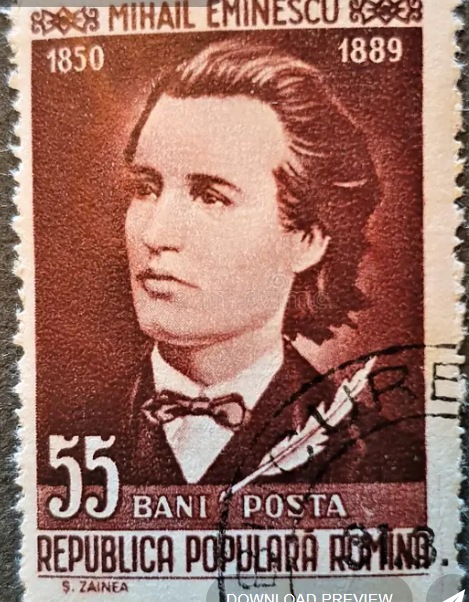
Mihai Eminescu (1850–1889) is universally recognized as the National Poet of Romania and Moldova. A late Romantic genius, Eminescu was not just a poet; he was a novelist, journalist, and philosopher who single-handedly reshaped and modernized the Romanian language. His work captured the spiritual essence of the Romanian people, blending folklore, philosophy, and profound emotional depth.
1. Early Life and Education
Mihai Eminescu was born on January 15, 1850, in Botoșani, Moldavia (now part of Romania). He spent his idyllic childhood in the scenic village of Ipotești, surrounded by nature and steeped in traditional folklore—themes that would deeply color his future poetry.
He received his early education in Chernivtsi (now in Ukraine). Later, between 1869 and 1874, he studied philosophy, law, and history in Vienna and Berlin. During his time in Germany, he was profoundly influenced by Western philosophy, particularly the pessimistic outlook of Arthur Schopenhauer and the critical philosophy of Immanuel Kant. He also developed a keen interest in Sanskrit and ancient Indian philosophy.
2. Literary Career and "Junimea"
Eminescu’s literary genius became evident during his student years. He joined Junimea (The Youth), the most prestigious Romanian literary society of the 19th century, led by the critic Titu Maiorescu.
Through the society’s journal, Convorbiri Literare (Literary Conversations), Eminescu published his greatest works. Maiorescu quickly recognized Eminescu's unmatched talent, shielding him from critics and establishing him as the leading light of Romanian Romanticism.
3. Core Themes and Style
Eminescu is considered the last great representative of European Romanticism. His poetry is characterized by a unique musicality and addresses several profound themes:
Nature and Love: His early poems portray nature as an enchanting, comforting sanctuary, often intertwined with the bittersweet experience of lost or unfulfilled love.
Cosmic Philosophy and Existentialism: Heavily influenced by Schopenhauer, Eminescu’s work often touches upon cosmic loneliness, the fleeting nature of time, the vanity of human existence, and the pain of the genius who cannot fit into a mundane world.
National History and Myth: He drew immense inspiration from Romanian history and folklore, weaving local myths into grand epic narratives.
4. Masterpieces
Luceafărul (The Evening Star)
Published in 1883, Luceafărul is Eminescu’s ultimate masterpiece and one of the greatest achievements in world literature. An epic poem consisting of 98 stanzas, it tells the story of an immortal evening star (Hyperion) who falls in love with a mortal princess. To be with her, he asks God to strip him of his immortality, only to realize that mortals are fickle and incapable of understanding his cosmic nature. The poem serves as a brilliant allegory for the isolation of a genius in a materialistic world.
Scrisorile (The Satires / Epistles)
A collection of five philosophical and satirical poems. They cover a wide array of topics, from the creation and destruction of the universe (in Satire I) to sharp critiques of contemporary Romanian politicians, fake intellectuals, and social hypocrisy.
Doina
A profoundly patriotic and melancholic poem that addresses the struggles, foreign occupations, and sorrows of the Romanian people, capturing the unique Romanian concept of dor (a deep, bittersweet longing).
5. Journalism and Political Stance
Beyond poetry, Eminescu was an influential political journalist. He served as the editor-in-chief of Timpul (The Time), the official newspaper of the Conservative Party.
In his articles, he was a fierce defender of Romanian national identity, sovereignty, and the working class. He fiercely critiqued corruption, the rapid Westernization that ignored local realities, and the exploitation of the peasantry. His sharp, uncompromising pen earned him many powerful political enemies.
6. Tragic Final Years and Legacy
Eminescu’s life took a tragic turn in 1883 when he suffered his first severe bout of mental illness, later diagnosed by historians as bipolar disorder, complicated by inadequate medical treatments of the era. He spent his final years drifting in and out of sanatoriums, unable to write consistently.
On June 15, 1889, at the young age of 39, Mihai Eminescu passed away in a Bucharest clinic. He was laid to rest under a weeping willow tree at the famous Bellu Cemetery in Bucharest.
Why He Matters Today
Eminescu is more than a historical literary figure; he is a cultural pillar.
Architect of Language: Before Eminescu, written Romanian was heavily fractured by regional dialects and archaic structures. He elevated the vernacular speech into a highly expressive, philosophical, and literary language.
National Culture Day: In honor of his immense impact, his birthday (January 15) is celebrated annually as Romania’s National Culture Day.
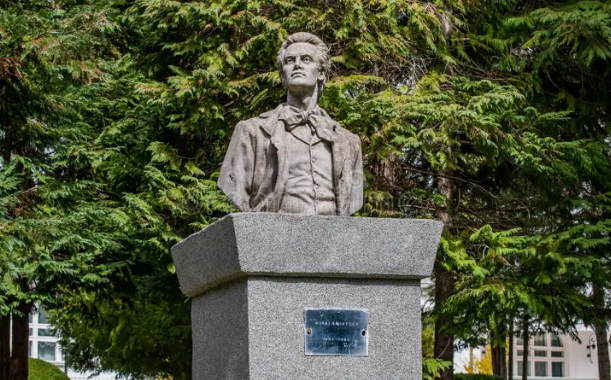
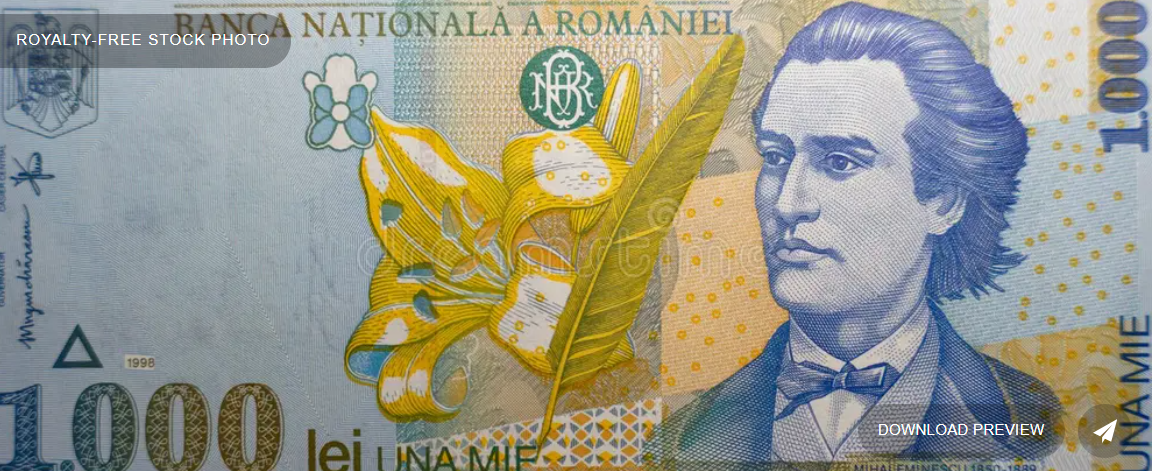
An Enduring Icon: His face graces Romanian currency (the 500 Lei note), and statues of him can be found in almost every major Romanian town, as well as in world cultural centers like Paris, Vienna, and Montreal.













جوابات (0)