


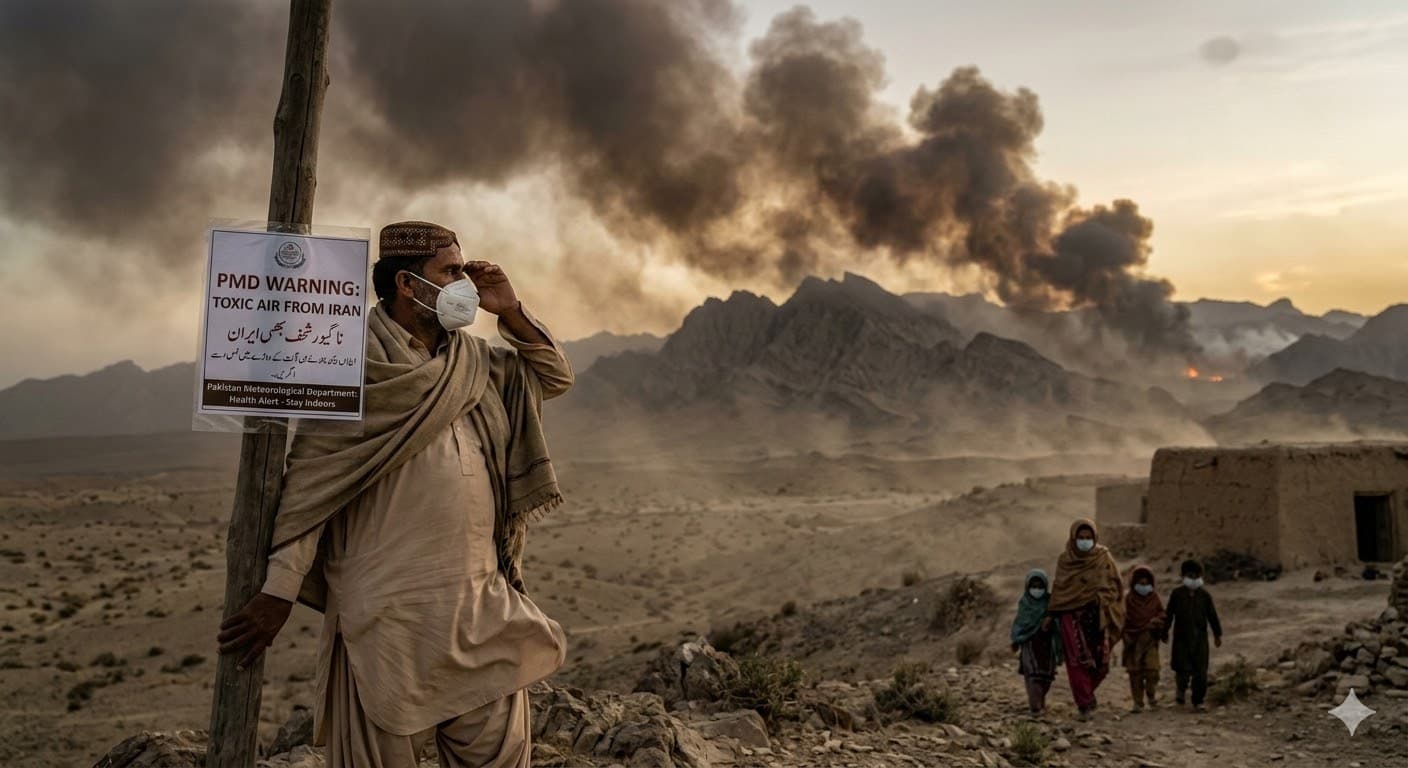
ISLAMABAD — The Pakistan Meteorological Department (PMD) issued an urgent environmental advisory on Monday, March 9, 2026, warning that a shift in wind patterns could carry toxic air and hazardous pollutants from conflict zones in Iran into Western Pakistan. As a powerful westerly wave approaches the region, meteorologists fear that smoke and chemical residue from recent airstrikes on Iranian oil refineries will significantly deteriorate air quality in Balochistan and neighboring border areas.
The Source of Transboundary Pollution
The environmental threat stems from escalating regional tensions and recent military strikes on major Iranian fuel depots and refineries. These attacks have triggered massive oil fires, releasing a "toxic cocktail" of:
Hydrocarbons and nitrogen oxides.
Sulfur dioxide and carcinogenic particulate matter (PM2.5).
Thick soot that has already caused "black rain" in Tehran.
According to the PMD, while the most severe pollution is currently concentrated over Iran and Afghanistan, the incoming weather system may push these plumes toward Pakistan’s western corridor.
Health Risks and Weather Forecast
Authorities have expressed concern over the potential health impacts on residents in the line of the wind's path. The Iranian Red Crescent has already warned that these pollutants can cause chemical lung damage and skin irritation.
While the PMD noted that no "black rain" has been recorded in Pakistan yet, the department is closely monitoring the situation via satellite, as ground data from Iran remains limited due to regional internet disruptions.
Rain and Thunderstorms Predicted for Upper Pakistan
Alongside the pollution warning, the Met Office has forecast a period of unstable weather across the country’s northern regions.
Moderate to Heavy Rain: Expected in Chitral, Swat, Abbottabad, and Gilgit-Baltistan through March 12.
Dust and Thunderstorms: Likely to hit Islamabad, the Potohar region, and parts of Khyber Pakhtunkhwa.
Temperature Drop: A decrease of 3°C to 4°C is anticipated in upper regions following the rainfall.

















Responses (0)