By: Abid Siddique Chaudhry
Pakistan’s environmental watchdog steps up anti-smog drive in Islamabad, inspecting 1,000 vehicles, seizing 80, and cracking down on polluting industries.
Key Points
- Over 1,000 diesel vehicles inspected and 80 seized for violating NEQS.
- Four new emission testing stations set up across Islamabad.
- Crackdown expanded to brick kilns, marble units, and steel industries.
- Anti-smog actions part of short-, medium-, and long-term national air-quality strategy.
- Public urged to cooperate as Pakistan treats smog as a public health emergency.
ISLAMABAD Pakistan News Today: Anti-Smog Drive Intensified to Protect Public Health
In a major move to curb rising winter smog, the Pakistan Environmental Protection Agency (Pak-EPA) has stepped up inspections of vehicles and industrial units across the capital, seizing non-compliant transport and demolishing outdated brick kilns. The action—closely coordinated with the Ministry of Climate Change and Environmental Coordination (MoCC)—comes as Pakistan faces increased scrutiny from the international community, including UN-linked climate bodies, over deteriorating air quality and environmental governance.
The crackdown supports broader goals under Pakistan’s National Clean Air Policy, aligning with global efforts on pollution control, climate resilience, and public health protection—topics frequently highlighted in world news, diplomatic dialogues, and environmental forums.
Why This Matters (Context for Global & National Readers)
Air pollution in Pakistan has become a matter of national security, foreign policy relevance, and international cooperation. Smog in major cities has triggered travel advisories, impacted trade mobility, and raised concerns among global partners such as the UN Environment Programme (UNEP) and South Asian regional bodies. Islamabad’s intensified response demonstrates Pakistan’s intent to align with global clean-air commitments and strengthen its international environmental profile.
Crackdown on Vehicles: 1,000+ Inspected, 80 Impounded
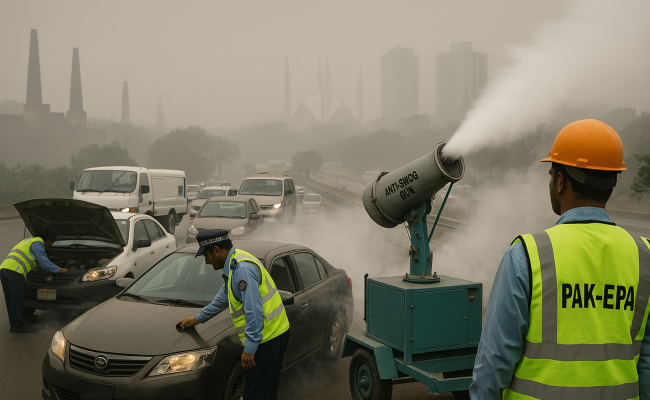
Since the launch of the anti-smog operation on December 1, Pak-EPA teams—working with the Islamabad Traffic Police (ITP)—have inspected more than 1,000 diesel-powered vehicles entering Islamabad. Over 300 challans were issued and 80 vehicles impounded for violating the National Environmental Quality Standards (NEQS) on emissions and noise.
Pak-EPA Director General Nazia Zaib Ali said the drive forms part of coordinated short-, medium-, and long-term measures involving the CDA, ICT Administration, and MoCC.
“We cannot allow non-compliant vehicles at any cost to poison the city’s air,” DG Ali said. “Violators are being penalised without exception.”
To boost enforcement capacity, four new Emission Testing Stations have been established at D-Chowk, Lake View Park, Metro Cash & Carry, and F-9 Park.
Crackdown on Industries: Kilns Demolished, Factories Sealed
Pak-EPA Director Dr Zaigham Abbas said enforcement has intensified across industrial zones:
- All 30 brick kilns in Islamabad converted to zigzag technology.
- Three non-compliant kilns demolished.
- Out of 48 marble factories in Sangjani, 32 found compliant, while 16 remain under scrutiny and three sealed.
- Two steel manufacturing units in I-10 Industrial Area continue 24/7 monitoring through live camera feeds.
“Our goal is not only enforcement but helping industries transition to cleaner production,” Dr Abbas said.Smog Sources & Scientific Data
Recent research cited by Pak-EPA highlights the transport sector as the biggest smog contributor:
- 43% of emissions in Punjab tied to transport.
- In Lahore, the figure rises to 83%, according to a 2023 Urban Unit study.
This aligns with global findings by agencies such as the World Bank and UN climate bodies on transport emissions in developing economies.
Short-, Medium-, and Long-Term Clean Air Strategy
Short-Term Actions
- Intensified checking of high-emission and ageing vehicles.
- Deployment of anti-smog guns in hotspot areas.
- Daily field operations and on-spot penalties.
Medium-Term Measures
- Expansion of Pakistan’s air-quality monitoring network.
- Enhanced technical capacity and interprovincial coordination.
- Large-scale tree plantation campaigns.
- Revisions to the national environmental legal framework.
Long-Term Reforms
- Implementation of Electric Vehicle (EV) Policy 2025.
- Introduction of an old-vehicle retirement system.
- Wider availability of cleaner fuels.
- Full enforcement of the National Clean Air Policy 2023.
Government Response & Public Awareness
Ministry spokesperson Muhammad Saleem Shaikh emphasized that public cooperation is vital.
“The government is treating air pollution as a public health emergency. Clean air is not a privilege but a constitutional right,” he said.
Pak-EPA has directed government and private organisations in Islamabad to immediately test their entire vehicle fleets at certified labs. Twenty-eight organisations have received notices for non-compliance.
DG Nazia Zaib Ali urged citizens to avoid unnecessary travel, reduce emissions, use masks during high-smog hours, and refrain from open waste burning.
Background: Pakistan’s Environmental Commitments in Global Forums
Pakistan remains an active participant in UN climate negotiations, regional cooperation platforms such as SAARC, and global environmental initiatives. The country’s air pollution challenge is frequently discussed in diplomatic dialogues, development programs, and international funding frameworks—making strict enforcement in Islamabad an important signal to global partners.
What Happens Next
With winter smog intensifying across northern Pakistan, Pak-EPA’s enforcement campaign is expected to widen. Additional monitoring stations, stricter industrial audits, and stronger cross-provincial coordination will shape Pakistan’s broader strategy to meet regional and international environmental obligations.